AI Vision Recognition Solutions (Skeletal, Licence Plate, People Counting and Biological Recognition)
P-Square's vision recognition solutions are built around the AI Box, combining discriminative AI (skeletal detection, licence plate recognition, people counting) with generative AI (image and video generation). The AI Box uses a cross-platform architecture (Jetson Nano / Jetson Orin Nano / notebook / PC), supports multiple simultaneous camera streams, and offers an optional UWB positioning module so that seeing and locating happen on the same device. Deployed with partners including ASKEY and NISSAN.
Six Applications
1. Dual-Camera AI Fitness and Rehabilitation
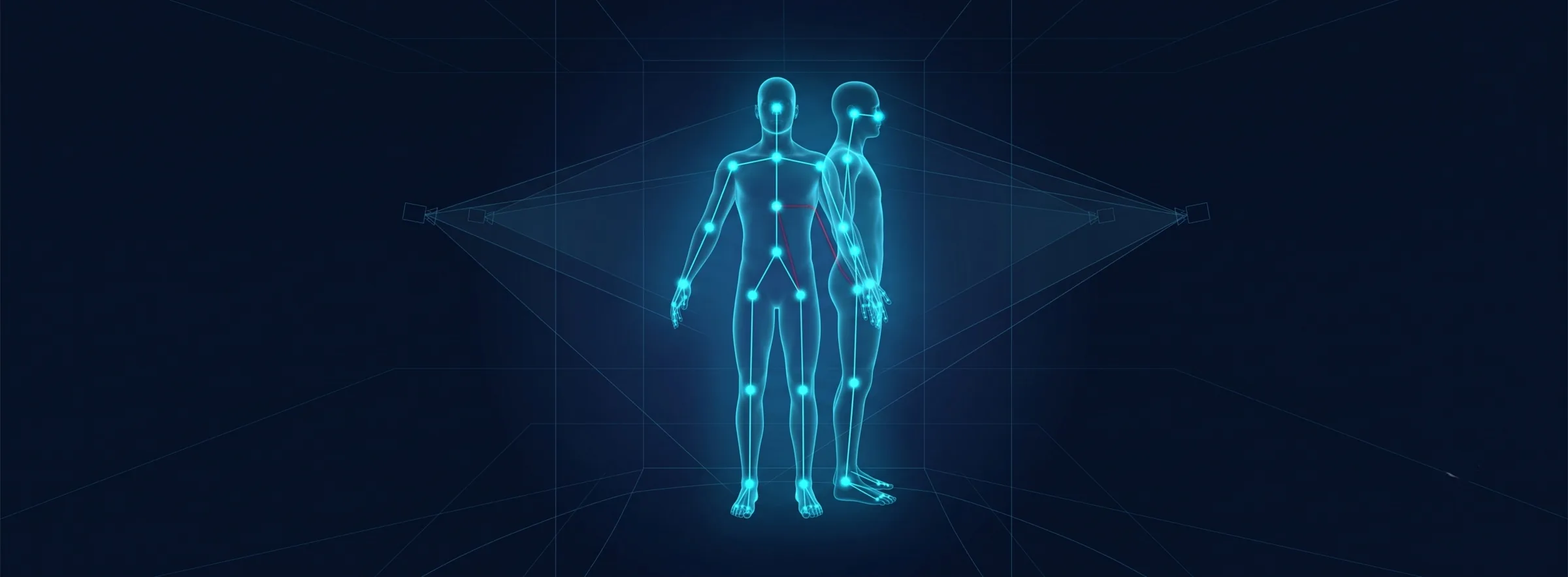
Two cameras perform AI skeletal keypoint recognition from the front and the side simultaneously, detecting frontal features such as uneven shoulders alongside lateral wrist range of motion. Users see their own posture on screen and correct it themselves, avoiding injury from poor form. Wrist position also acts as a mouse, so operating the system exercises the upper limbs. Deployed in long-term care for stretching and activation exercises such as the shot-put game.
2. AR Photo Studio
AI skeletal recognition captures body position and movement precisely, so photographs can be taken with no physical props. Older users wave their right hand to choose virtual accessories and send the result to friends; barbell and dumbbell accessories only appear when both arms are raised and lowered, combining entertainment with exercise.
3. High-Precision Dynamic Licence Plate Recognition
As deployed with NISSAN: vehicles do not need to stop for recognition, direction of travel is determined dynamically, and multiple floors and several vehicles entering or leaving at once are supported.
4. Bus Seat and Occupancy Analysis
As deployed with ASKEY: recognition rules are derived from large-scale analysis of facial image samples and continuously optimised as the sample set grows. Built on AI deep learning for high precision, developed on the open Jetson Nano platform for extensibility, supporting both USB cameras and IP cameras.
5. Fish Species AI Recognition
As deployed at Farglory Ocean Park: the host reads the camera feed and performs recognition, and the back end derives the coordinates and classification of each fish in the image. Selecting a fish displays its photograph and detailed information.
6. Natural Language Program Generation
Requirements entered in plain language are turned automatically into a structured flowchart, with support for logic checking, condition completion, test validation and report generation. Five design modes (A–E) provide layered support by process complexity, from basic generation through to advanced testing and environment completion; a modular design allows flexible combination, improving design efficiency, reducing errors and ensuring process consistency and traceability.
System Specifications
| Item | Specification |
|---|---|
| Cameras | Any IP camera supporting RTSP; USB cameras also supported |
| Host | Linux or Windows; supports six or more simultaneous camera streams |
| AI Box platform | Cross-platform: Jetson Nano / Jetson Orin Nano / notebook / PC |
| Positioning option | Optional UWB positioning module on the AI Box |
| Integration | RESTful API delivering JSON (licence plate number, timestamp and similar) |
| Customisation | Training tools for licence plate formats in other countries; object code or source code available |
Where It Is Used
- Long-term care and healthcare: dual-camera rehabilitation and activation exercise, AR photo studio interaction
- Car parks, residential complexes and plants: dynamic licence plate recognition without stopping, multi-floor support
- Public transport: bus seat and occupancy analysis
- Aquariums and educational venues: fish species recognition and interactive guidance
- Software development: natural language to flowchart conversion and automated test assistance
Frequently Asked Questions
Do we need special cameras?
Can licence plate recognition be used outside Taiwan?
Why use two cameras rather than one?
How does AI vision relate to your positioning technology?
Vision covers what positioning misses: a camera counts the people in frame, so if eight people are present but only six tags report in, you immediately know someone is not wearing a tag or a tag has failed. Wireless positioning alone cannot see this — a person without a tag simply does not exist to the system, which matters for safety headcounts and access control.
Positioning covers what vision misses: once a person is behind a machine, a rack or a corner the camera loses them, but UWB and Bluetooth signals penetrate and diffract, so the position never drops out — the same applies in backlight, dust or darkness. Vision is most accurate within line of sight; wireless positioning handles everything beyond it.
In practice the two are layered: the AI guidance robot uses LiDAR SLAM, RGBD imaging and UWB relative positioning together.
How do recognition results integrate with our existing systems?
Systems That Both Recognise and Locate
Contact the P-Square project team to discuss integrating AI vision recognition with positioning.
Professional Consultation