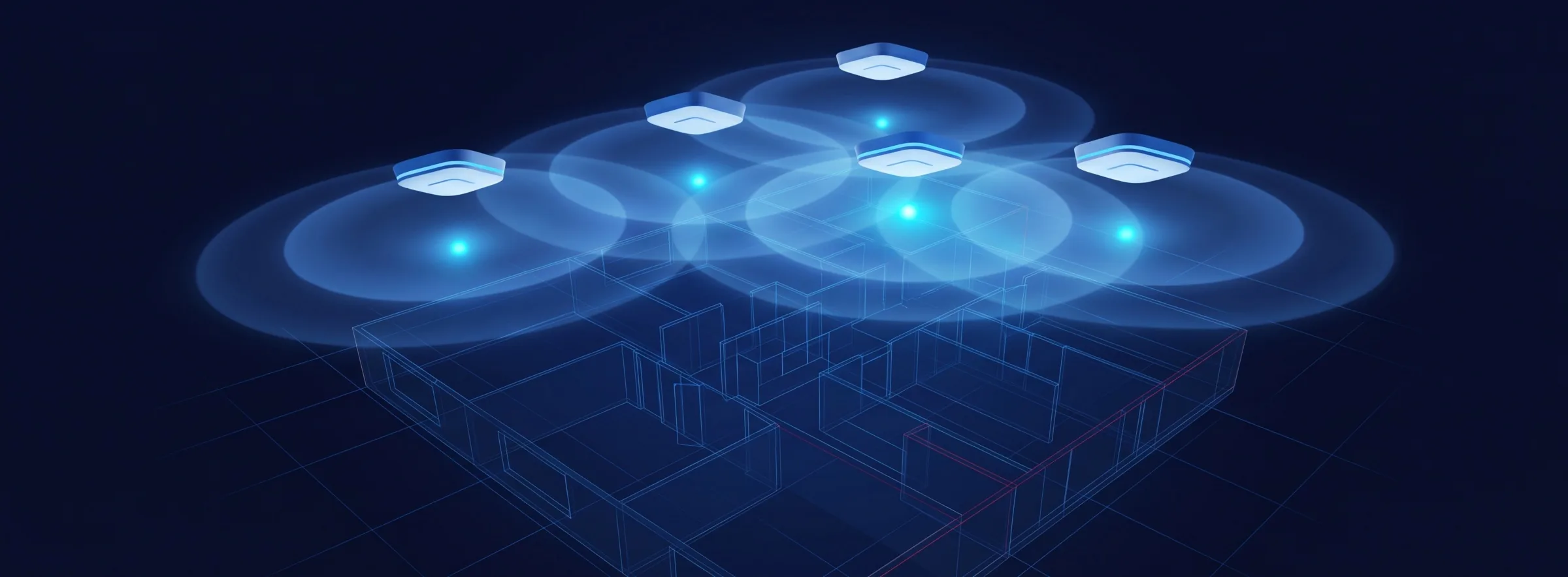
Wi-Fi Indoor Positioning (Reuse Existing APs, Lowest Deployment Cost)
Where a site already has Wi-Fi, Wi-Fi positioning is the lowest-cost option — existing APs are reused and no rewiring is required, delivering data transport and positioning from the same infrastructure. P-Square's proprietary AI Fingerprinting (RF Fingerprinting) algorithm overcomes Wi-Fi signal disturbance in partitioned environments, and measured positioning performance outperforms solutions from major international networking vendors such as Cisco and Ruckus. Deployed at a leading domestic semiconductor manufacturer for emergency response team safety, night-shift safety, duress alerts and restricted-zone warnings.
Architecture 1: Smartphone Positioning (Wi-Fi AP / BLE Beacon)
← Swipe horizontally to view the full diagram →
Figure: smartphone positioning — the position is computed on the handset before being reported, a distributed architecture.
Personnel carry a Wi-Fi Mobile device or Wi-Fi tag and are positioned from the signals of multiple Wi-Fi APs; the scanned signals are sent to the back-end server for computation and display on the web platform. An alternative is for the user's handset to compute its own position before reporting it. This distributed architecture has two benefits: (1) performance holds as user numbers grow, giving excellent scalability; (2) it resolves differences between handset brands (Huawei, OPPO, Xiaomi, HTC, Samsung, Sony and others).
Position computation on the handset is handled by the positioning library we supply, which drops into the customer's existing Android app. The site reuses the Wi-Fi it already has, with no extra hardware to install. It is in service for merchandise location in retail stores and personnel location in factories.
Architecture 2: The AI Fingerprinting Algorithm
← Swipe horizontally to view the full diagram →
Figure: AI Fingerprinting architecture — fuses IMU, RF signals and structured map data to output positioning with partition determination.
Conventional positioning degrades as partitions increase and is poorly suited to indoor environments with many obstacles and rooms; trajectories often jump erratically or land in impossible places such as inside a pillar, which makes projects difficult to sign off. P-Square addresses this with three innovations protected by 8 granted patents:
- AI multi-dimensional pattern matching — a multi-dimensional and directional algorithm delivering precise positioning in critical areas such as rooms and inside/outside doorways.
- Structured graph map algorithm — a Structured Graph Map that keeps trajectories realistic and path analysis accurate.
- Heterogeneous device correction — a self-adaptive mechanism resolving the differing signal characteristics of handsets and tags, and shadowing effects.
The algorithm is hardware independent and supports RSSI, AoA, ToA, TDOA and UWB, which is why P-Square can partner with many classes of hardware vendor and keep its business model flexible.
Four Limitations You Should Know About (We State Them Openly)
| Limitation | Explanation | Mitigation |
|---|---|---|
| iPhone does not support Wi-Fi scanning | iOS does not expose surrounding Wi-Fi AP scan results to third-party apps, so pure Wi-Fi positioning cannot cover iPhone users. | Pair with BLE beacon smartphone positioning where iPhone coverage is required, or use site-side tag positioning. |
| Android 10 and above requires developer mode | Android 10 onwards restricts Wi-Fi scan frequency; continuous scanning requires developer mode. | Use a Wi-Fi tag or a Bluetooth solution instead, or configure company-owned devices centrally via MDM. |
| Wi-Fi scanning draws more power | Compared with Bluetooth, Wi-Fi scanning consumes noticeably more power, affecting battery life. | For staff wearing a device all day, use Bluetooth tags (about one year of runtime); Wi-Fi positioning suits handheld terminals or mains-powered devices. |
| Scanning is throttled with the screen off or the app in the background | To save power, both Android and iOS heavily reduce or suspend scanning once the app goes to the background or the screen turns off, so position updates slow down or stop. | We have an answer on both platforms: on Android a foreground service with a persistent notification keeps scanning alive; on iOS Core Bluetooth background modes and beacon region monitoring wake the app. Where the site needs continuous, reliable updates, switch to site-side tag positioning, which is unaffected by handset power saving. |
Recommended Positioning Server Specification
| Item | Specification |
|---|---|
| Operating system | Windows 11 (64-bit) or Windows Server 2022 / 2025; Linux also supported (Ubuntu 22.04 LTS or later) |
| CPU | Intel Core i5 12th generation or later, or equivalent Xeon, quad core and above |
| Memory | 16 GB or more |
| Storage | 512 GB SSD or more, depending on how long history is retained |
| Supported methods | Wi-Fi AP smartphone positioning, BLE beacon smartphone positioning |
| Beacon requirement | Bluetooth 4.0 or above |
| Handset support | Android for Wi-Fi positioning; BLE beacon positioning recommended for iOS |
Case Study: Leading Domestic Semiconductor Manufacturer
Personnel carry a Wi-Fi Mobile device or Wi-Fi tag and are positioned from multiple Wi-Fi AP signals, which are sent to the back-end server for computation and displayed on the web platform. Benefits realised:
- Emergency response team safety
- Improved night-shift safety
- Duress alerts
- Restricted-zone warnings
The site also applied Wi-Fi positioning to live headcount during fire drills and went on to take first place in the group-wide inter-fab drill assessment. The solution reuses existing plant Wi-Fi APs with no rewiring, making it the lowest-cost route for an operating facility.
A leading domestic petrochemical group uses the Mobile Beacon system: users carry Android or iOS handsets, fixed BLE beacons are deployed across the site, the handset computes its position from beacon signals and reports it over Wi-Fi or 4G/5G to the back-end server for wayfinding, navigation and business intelligence analysis on the web.
Where It Is Used
- Semiconductor and high-tech plants: wide-area personnel positioning, material distribution by zone, fire-drill headcount
- Petrochemical and energy: wide-area personnel positioning and duress alerts
- Shopping centres and exhibition halls: shopper smartphone positioning and circulation analytics (cheapest where Wi-Fi exists)
- Hospitals and long-term care: mixed deployment with Bluetooth Locators, balancing coverage and accuracy
Frequently Asked Questions
We already have Wi-Fi in the plant — can we really use it for positioning?
What accuracy does Wi-Fi positioning achieve?
How does performance compare with Cisco or Ruckus?
Why emphasise that the algorithm is hardware independent?
What server specification is required?
Turn the Wi-Fi You Already Have into Positioning
Contact the P-Square project team to assess whether your existing APs can support your positioning requirements.
Professional Consultation