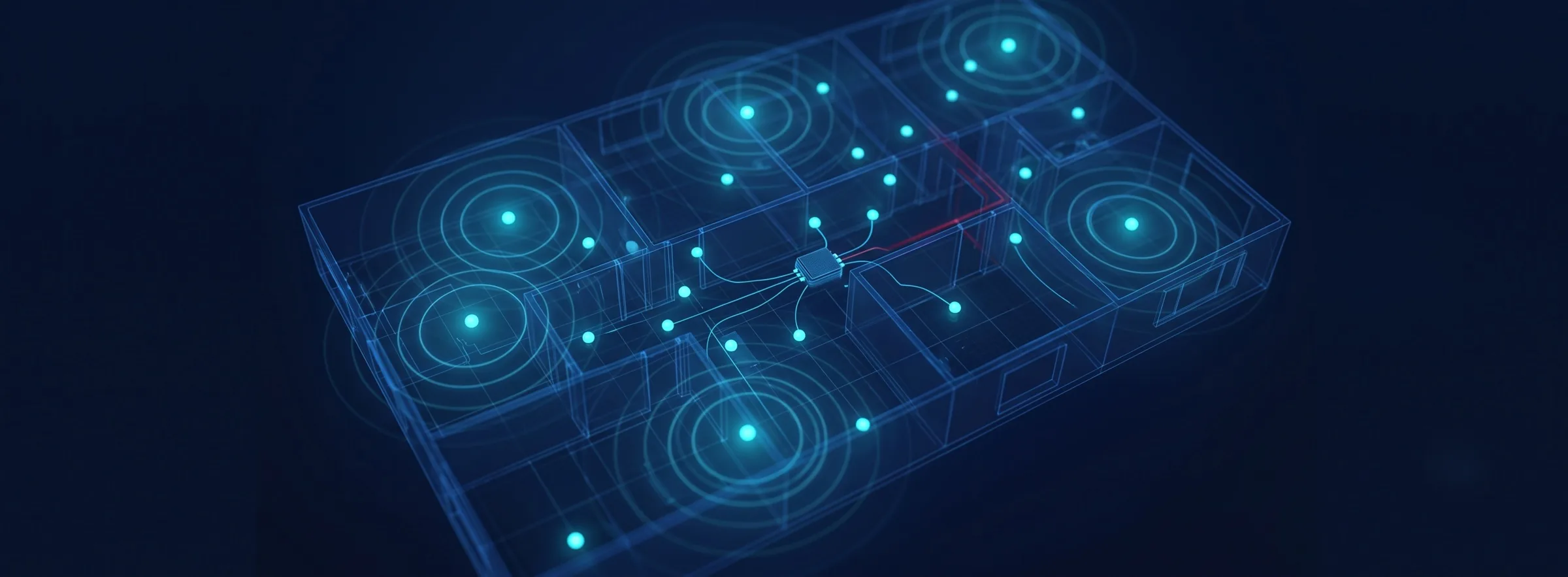
Bluetooth BLE Indoor Positioning (Locator / Beacon / Bluetooth 6.0)
Bluetooth positioning is P-Square's most cost-effective solution: tags are low power with roughly one year of battery life, hardware cost is low, and one Locator drives four read heads covering five points, cutting hardware volume to about a fifth and dramatically reducing cabling work. Four Bluetooth architectures are available, and P-Square is actively developing algorithms for Bluetooth 6.0 Channel Sounding (phase-based ranging). Deployed at a leading semiconductor manufacturer, healthcare providers, automotive plants (BMW, Audi) and construction sites.
Architecture 1: Bluetooth Locator Positioning
← Swipe horizontally to view the full diagram →
Figure: Bluetooth Locator architecture — tags advertise, Locators scan, and the back end computes position with AI Fingerprinting.
Personnel, trolleys and assets carry BLE tags that advertise continuously; fixed Locators deployed across the site scan for them. Locators forward the signals over Ethernet to a switch (or through a plant private 5G network) to the positioning server, where the AI Fingerprinting algorithm computes position for display on the web platform.
The cost efficiency comes from the deployment model: one Locator unit can drive four extension read heads, covering five points in total. Compared with one unit per point, hardware volume falls to about a fifth and installation and cabling costs fall with it. Locators are compact and can be installed under raised flooring or inside suspended ceilings without affecting the appearance of the site.
Architecture 2: Bluetooth 6.0 Channel Sounding
← Swipe horizontally to view the full diagram →
Figure: Bluetooth 6.0 Channel Sounding — phase difference replaces RSSI estimation for far more precise ranging.
Estimating distance from RSSI signal strength and then solving position by trilateration is readily disturbed by obstruction, human bodies and metal structures, so the error is large. P-Square’s mainstay AI Fingerprinting also reads RSSI, but never converts it into a distance — it matches the pattern of signals measured on site against a reference set built in advance, finding the position directly, so no distance-conversion error accumulates. In partitioned environments that is more than 30% more accurate than trilateration. The Channel Sounding introduced in Bluetooth 6.0 takes a third route, using PBR (Phase-Based Ranging): the Initiator and Reflector measure the phase difference across multiple channels to derive true range, breaking the RSSI limitation while retaining Bluetooth's low power draw and broad compatibility.
Ranging algorithms available under Bluetooth 6.0 include IFFT (inverse fast Fourier transform), Phase Slope, RTT (round trip time) and MUSIC (multiple signal classification). P-Square's core technology is an IFFT peak compensation algorithm based on PBR, validated on the Nordic nRF54L15-DK platform (Initiator / Reflector) with P-Square tags.
Four Bluetooth Positioning Architectures
| Architecture | How it works | Best suited to |
|---|---|---|
| 1. Locator-Tag | Tags advertise; fixed Locators scan and forward to the back end for computation. The Locator runs on an open platform (Raspberry Pi class), so it integrates flexibly: one unit extends over four 10 m USB cables to act as five sensing points, and it can be concealed above a suspended ceiling. Where a site already has Bluetooth tablets, those can serve as locators directly. | Personnel, trolley and asset tracking in plants, hospitals, automotive facilities and construction sites |
| 2. Mobile smartphone positioning | The user's handset scans fixed beacons and computes its own position before reporting it. | Visitor wayfinding, mall navigation, wide-area personnel positioning without issuing badges |
| 3. Beacon-Tag | Fixed beacons advertise continuously; a moving tag scans RSSI and re-advertises, and Locators receive it for AI Fingerprinting computation. | Sites where the tag must do the scanning; display via HDMI screen or a browser connected directly to the Locator |
| 4. Bluetooth 6.0 Channel Sounding | Phase-based ranging replaces RSSI estimation for precise distance measurement. | Next-generation deployments: indoor positioning, asset tracking, smart wearables, safety monitoring |
Bluetooth Hardware Specifications
| Item | PTG_001 (label) | PTG_002 (wristband) | PTG_003 (label) |
|---|---|---|---|
| Bluetooth version | Bluetooth 5.0 | Bluetooth 5.0 | Bluetooth 5.0 |
| Dimensions / weight | Φ39 × 15.5 mm, 50 g | Φ35.9 × 11 mm | 38 × 38 × 9 mm |
| Antenna | PCB antenna | PCB antenna | PCB antenna |
| Advertising interval | 100 ms – 5000 ms | 100 ms – 5000 ms | 100 ms – 5000 ms |
| TX power | -40 to +4 dBm (8 steps) | -40 to +4 dBm (8 steps) | -8 to +4 dBm |
| Battery / runtime | CR2477, about 1 year at 1 advertisement/second | CR2032, about 4 months | CR2032, about 3 months at 1 advertisement/second |
| Warranty | 1 year | 1 year | 1 year |
A BT-Dongle USB Bluetooth receiver is also available (22 × 16 × 6 mm, NCC CCAJ14LP4120T2). PTG_001 carries CE, FCC, RoHS, REACH approval.
Field Deployments
Construction site Locator system
Deployment scale at a single site for a major domestic construction contractor:
- 66 locating devices across 5 floors
- 5 gateways connected to the router over Ethernet
- 61 Locators relaying data over a mesh network
- 30 tags (BLE 4.0), six of which carry a g-sensor and duress button
- Fire-resistant and waterproof housings; power adapters BSMI certified
Leading domestic semiconductor manufacturer: people and asset tracking
Locators were deployed over the plant’s existing network, with tags carried by staff and fitted to trolleys:
- 65 Locators covering the production area
- Over 300 tags, on both people and assets
- Used for people and asset tracking, cutting the time spent looking for staff and materials and improving day-to-day efficiency
Where It Is Used
- Semiconductor and manufacturing: personnel duress, trolley and material container search, movement heat maps
- Healthcare: medical equipment tracking, one-touch clinical duress, infection-control contact tracing
- Automotive: personnel and asset tracking, as deployed for BMW and Audi
- Construction sites: multi-floor personnel tracking, duress alerts, mesh backhaul
- Long-term care: geofenced wandering prevention, fall reporting, wristband tags
- Hotels, kindergartens and schools: trolley, asset and personnel tracking
Frequently Asked Questions
How long do Bluetooth tag batteries last?
What does one Locator driving four read heads actually save?
Does Bluetooth positioning lose accuracy in heavily partitioned buildings?
Is Bluetooth 6.0 Channel Sounding available now?
Deploy Bluetooth Positioning at a Sensible Cost
Contact the P-Square project team to assess Locator density and tag selection.
Professional Consultation