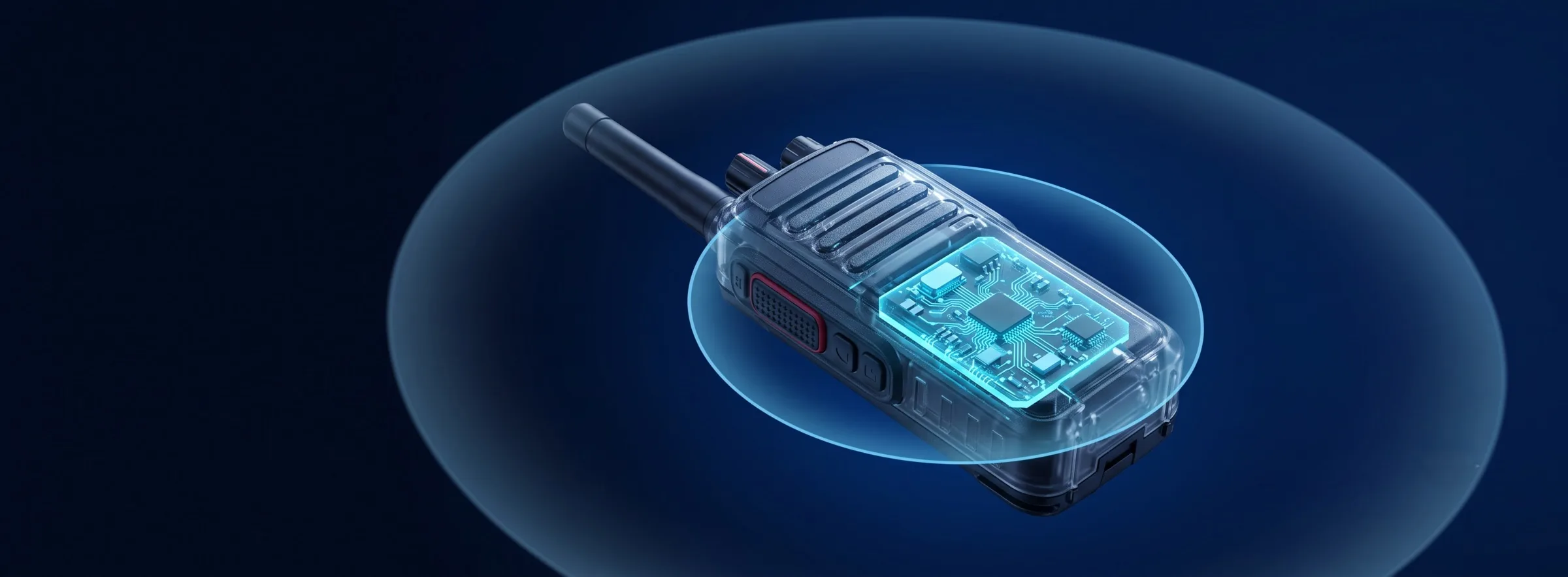
Turn "Calling Someone" into "Knowing Where They Are" — Seeking Two-Way Radio and PoC Vendors to Co-Create Safety Communication Devices
A two-way radio solves reaching someone. What workplace safety actually needs is knowing where they are. P-Square seeks DMR digital radio and PoC network radio vendors to co-create positioning-enabled safety communication devices — you own the hardware, we provide the indoor positioning algorithm.
2. Industry Focus: Safety Communication Abroad Has Converged on Communication + Location + Duress
A single device integrating communication, location and duress is now standard in the safety market
Worker safety solutions abroad have long stopped being communication devices alone — the radio also integrates satellite positioning, fall and no-motion detection, one-touch duress and real-time back-end monitoring into a single unit. For high-risk industries such as petrochemicals, construction, mining and utilities, whether the system can immediately locate someone in trouble is often the decisive purchasing criterion, ahead of communication quality.
Market signals
- Procurement logic has changed: the purchase is no longer a radio but a safety solution, with higher unit value and stickiness.
- Regulation and audit drive it: occupational safety management requires traceable movement and event records, and the communication device is the natural carrier.
- Two technology tracks coexist: DMR digital radio and PoC over cellular each have their environments, and both need positioning.
The gap: satellite positioning fails indoors, and most incidents happen indoors
Almost all integrated safety communication devices rely on satellite positioning. But plants, cleanrooms, tunnels, basements and large warehouses — precisely the high-risk areas — are exactly where satellite signals cannot reach. The last reported position is often the door they walked through. This is the gap indoor positioning fills.
How indoor positioning covers it
- Bluetooth / Wi-Fi positioning: reuses existing site networks or deploys at low cost, resolving floor and zone.
- UWB positioning: 10–30 cm accuracy in critical areas, suited to high-risk work zones.
- No-motion alerting: prolonged immobility in a zone raises an automatic alert without the user having to press anything.
3. Value-Add Pain Points for Radio Vendors, and What P-Square Offers
Taiwanese radio and wireless vendors have complete RF design, certification and channel capability; what is missing is the indoor positioning algorithm and field experience.
What P-Square provides:
- Indoor positioning is the most visible gap in current safety devices: Satellite positioning is mature and free outdoors, but fails the moment a worker enters a plant, tunnel or basement. Adding indoor positioning takes the product from outdoor-trackable to trackable everywhere — a clear specification differentiator and a scoring advantage in tenders.
- Duress and no-motion detection are already implemented: P-Square tags already provide one-touch duress and prolonged-immobility alerting, running in semiconductor plants (cleanroom personnel duress integrated with the plant Emergency Response Centre), construction sites (tags with g-sensor and duress button) and hospitals (clinical duress). That event logic transfers directly onto a communication device.
- Hardware independent, no need to change your RF design: The algorithm supports BLE 4.0 / 5.0 / 6.0 Channel Sounding, Wi-Fi RSSI and UWB (ToA / PDOA), selectable by product positioning and cost. Most radios already carry a Bluetooth module, so firmware and algorithm work alone can give existing hardware indoor positioning without redesigning the RF circuit.
- A complete back end you do not have to build: P-Square provides the RTLS web platform: live map position, restricted-zone alerts, historical records, heat maps, trajectory replay and dwell-time analysis, with RESTful API and iframe integration into your existing dispatch or management platform.
4. Flexible Partnership Models: Co-Creating a Win-Win
Different entry points depending on your product stage and development resources:
| Partnership model | Who it suits | What it involves |
|---|---|---|
| Firmware and algorithm licensing | Existing DMR / PoC radio vendors | Most models already carry a Bluetooth module, so a firmware update with algorithm integration adds indoor positioning without hardware redesign. |
| Add-on positioning module | Value-add for existing models / channel partners | An external positioning module or accessory upgrades current models — suited to product lines that must answer tender requirements quickly without touching hardware design. |
| New model onboard integration | New-generation model developers | Integrate the positioning module and algorithm at the design stage for a differentiated model combining communication, location and duress in one device. |
| Joint grant applications and joint bidding | Listed and pre-IPO companies, communication majors, system integrators | Apply jointly for government occupational safety and smart-facility grants, or bid together on public sector and large enterprise safety tenders. |
5. Frequently Asked Questions
Our radios already have GPS — why add indoor positioning?
Do we need to redesign the hardware?
What has to be deployed at the site?
How does position data reach our existing dispatch platform?
Is this a module purchase relationship?
Or email service@p2-positioning.com · Tel +886-3-666-9151