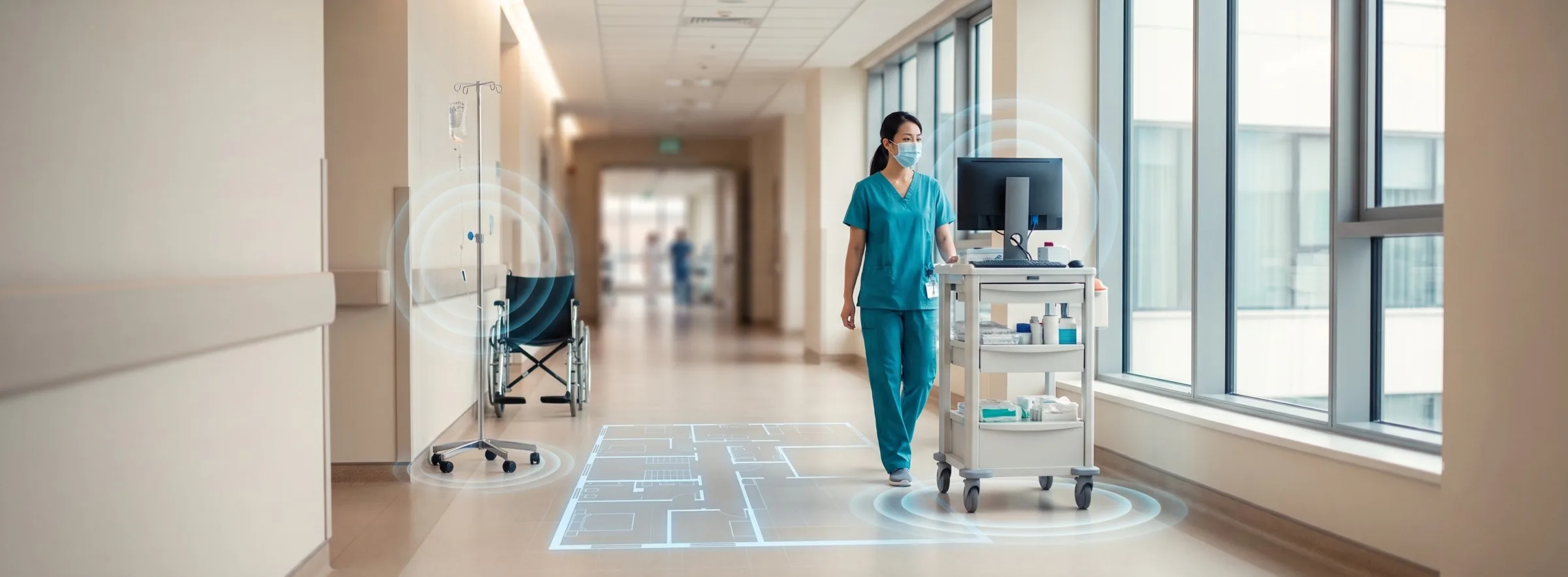
Hospital Equipment Tracking & Clinical Staff Positioning System
P-Square delivers an RTLS smart-hospital positioning solution combining BLE and UWB, covering nursing stations, emergency departments and operating theatres. It addresses mobile medical equipment that cannot be located, staff duress and workplace violence in the ED, and infection-control contact tracing. The system provides automatic asset stocktakes, one-touch staff duress and patient tracking. Deployed at a leading domestic medical centre (Bluetooth tracking of operating-theatre equipment) and other hospitals.
Pain Points and Solutions
| Unit | Pain Point | Solution |
|---|---|---|
| Nursing Station | Locating equipment at shift handover is slow; restricted areas must keep patients out; nursing trolley routes need to be fixed; drug storage location and classification must not be wrong. | Equipment tracking cuts handover time; instant alerts on restricted-area entry; trolley trajectory analytics and equipment utilisation reporting; drug storage location and dispensing records tracked. |
| Emergency Department | Arrival times of clinical staff are hard to manage; violence against staff is a real risk; medical devices move constantly and are hard to find; high infection exposure. | Automatic arrival-time tracking for critical-care staff; one-touch duress button deters violence and pushes live location; equipment tracking for rapid retrieval; personnel tracking supports isolation of potential infection sources. |
| Operating Theatre | Cleaning staff must be dispatched immediately; high-value devices move frequently; patients away from their bed are hard to locate. | Cleaning-staff dispatch and coordination; asset tracking for diagnostic, monitoring and ventilation equipment; patient tracking with automatic in-surgery / post-operative status. |
System Applications
Live tracking and automatic stocktake of wheelchairs, IV poles, infusion pumps and ventilators.

Know where clinicians and patients are — including patients away from their beds.
Cross-reference historical movement and push live information to designated zones.

Wayfinding for visitors and patients, reducing missed appointments.

Space guidance and find-my-car for a better overall visit.
Solution Modules
| Module | Positioning Technology | Accuracy / Coverage | Hardware | Core Value |
|---|---|---|---|---|
| Medical asset tracking | BLE / UWB | Room level / 10–30 cm | BLE medical asset tags | Cross-department dashboard for wheelchairs, IV poles, infusion pumps and ventilators |
| Clinical staff protection | Low-power BLE | Room level | Duress card / ID badge | ED anti-violence duress alerts with live coordinates to security |
| Infection-control tracing | BLE / Wi-Fi trajectories | Site-wide grid | Back-end software module | Cross-reference contact history and auto-generate infection-control reports |
Case Studies
Major Domestic Hospital — Bluetooth Tracking of Operating-Theatre Equipment
High-value theatre equipment moves constantly and is difficult to audit. Bluetooth tracking gives real-time visibility of diagnostic devices, monitoring equipment and ventilators.
- Significant reduction in equipment search time.
- Improved accuracy of automatic asset stocktakes.
- Higher redeployment rate for idle equipment.
Related deployment: a well-known domestic hospital — clinical duress system, with one-touch staff alerts and immediate location-guided response.
Major Hospital in Northern Taiwan — Bluetooth Tracking at the Nursing Station Cut Handover Time to One Third
The most time-consuming part of a nursing shift handover is confirming where every mobile medical device is. Wheelchairs, IV poles and infusion pumps move constantly between wards and floors, so handover staff had to walk the floors to complete the count. With Bluetooth tracking, the handover screen shows the ward and floor of every device directly — the check is completed without leaving the nursing station.
- Nursing handover time reduced to one third of its previous duration.
- Shift handover no longer requires walking floor to floor to find equipment, cutting administrative load.
- Improved nurse retention intent — less time spent on time-consuming non-clinical work.
- Equipment utilisation and idle time become measurable, enabling faster redeployment.
Why this matters: nursing shortages are a shared pressure across hospitals, and walking the wards to find equipment at handover is a textbook example of work that is time-consuming yet outside a nurse's clinical role. Returning that time to patient care often matters more to hospital management than the asset-tracking savings alone.
Leading Domestic Medical Centre — Preventing Violence in the Emergency Department and Hospital-Wide
The emergency department is where hospital violence concentrates: distressed relatives, or patients under the influence of alcohol or drugs, can escalate from an argument to physical assault within seconds. The traditional answer is a duress button on the wall plus a public address call — but by then staff have usually been pushed away from the wall, and an announcement cannot say which cubicle or which bed.
- The ID badge staff already wear is the duress button, and pressing it sends the location with the alert, so security and support see the floor, the room and the bed.
- High-risk zones (triage, psychiatric wards, night clinics) can raise the alert level automatically as staff enter them.
- Trajectories of those involved and of nearby staff can be replayed afterwards for incident reporting, review and evidence.
- The same system covers the whole hospital, not only the emergency department — wards, imaging rooms and car parks are all in scope.
Why start with the emergency department: it reports the highest number of violent incidents, and they cluster on night shifts and weekends — exactly when staffing on the floor is thinnest. Shortening the response time matters more than reviewing it afterwards.
Frequently Asked Questions
Will RTLS radio signals interfere with medical equipment?
Hospitals have many walls and complex departments — will partitions block positioning?
How does the system support infection-control contact tracing?
How are medical asset tags cleaned and disinfected?
How much can nursing shift handover time actually be reduced?
How does positioning actually help with the nursing shortage?
Improve Hospital Efficiency and Clinical Staff Safety
Contact the P-Square project team to plan positioning for nursing stations, emergency departments and operating theatres.
Professional Consultation