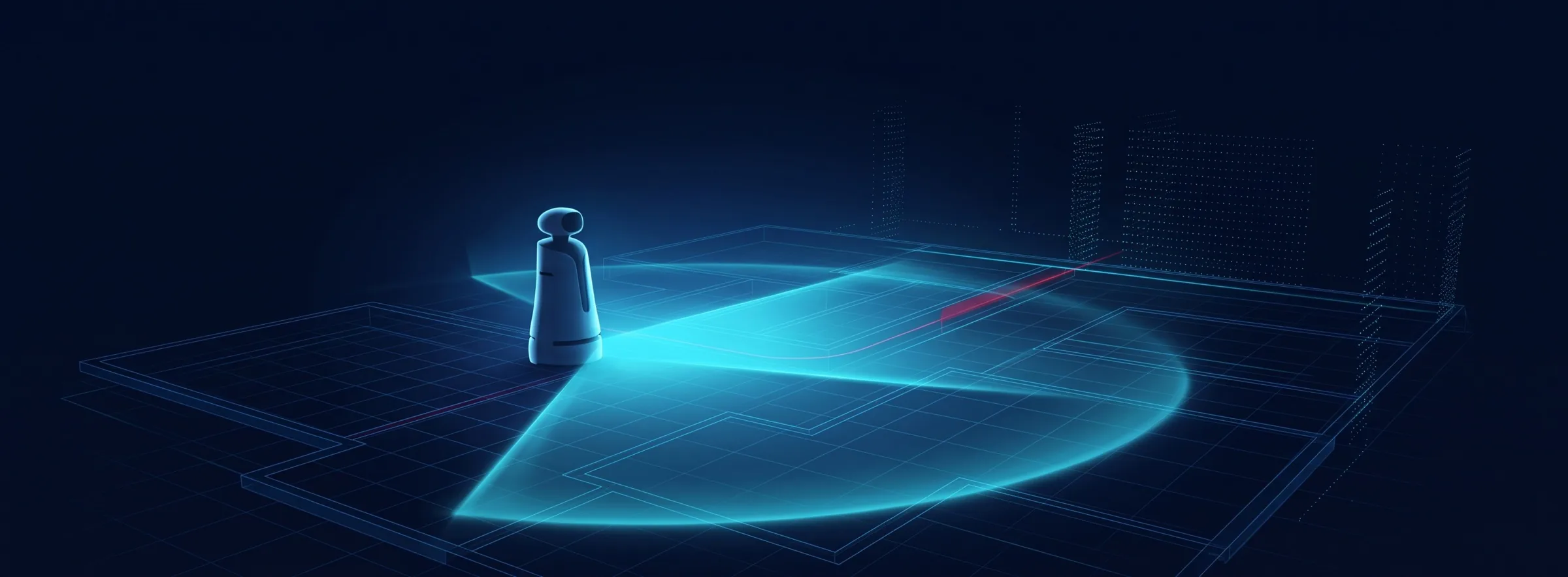
AI Collaborative Guiding Robot
Service robots navigate with lidar and cameras, which answers “where am I” but not “where are the people”. P-Square’s collaborative guiding robot adds two things: UWB relative positioning measures the bearing and range of people nearby and keeps working when they are hidden behind a rack or a corner; and location-based generative AI produces dialogue and guidance that matches where the robot actually is. The platform runs on ROS, so partners can build on it, publish and share revenue.
Who the robot is built for
| User | Robot role | What it solves |
|---|---|---|
| People with physical disabilities | Guiding robot | A support handle and a storage basket assist movement and carrying at the same time, without needing to ask for help |
| Older adults | Interaction / long-term care robot | Generative voice companionship and Q&A, night rounds, stretching and activation exercises |
| Schools | Smart robot | An open interface for students and faculty to build on, as a teaching and research platform |
| Site owners | Service / wayfinding robot | On-site guidance, information lookup and directions, reducing front-desk workload |
See it running: AI collaborative guiding robot demonstration (YouTube)
How it works: multi-sensor high-precision navigation
| Sensor | What it does | Why it is needed |
|---|---|---|
| Dual lidar | SLAM mapping and self-localisation | Answers “where is the robot”, but cannot identify who a moving object is |
| RGBD camera | Depth imaging, recognising obstacles and people ahead | Covers the lidar’s field-of-view limits and assists obstacle avoidance |
| Infrared / ultrasound | Close-range obstacle detection | Low, transparent or reflective obstacles are hard for lidar to read |
| UWB PDOA | Direct bearing and range to anyone wearing a tag | Answers “where are the people”, unaffected by lighting or line-of-sight blind spots |
| UWB ToA | Absolute coordinates with fixed anchors | A position reference across floors and large sites |
UWB relative positioning is the decisive one, because it lets the robot know before it can see. Lidar and cameras have to see something before they react, and the moment a person steps out from behind a rack or a corner the robot often has less than a second to stop. UWB signals penetrate and diffract, so the robot already has that person’s bearing and range before they come into view — enough warning to slow down, reroute or stop rather than brake hard on sight. Backlight, darkness and dust make no difference either.
Eight capabilities
| Capability | Detail |
|---|---|
| Multi-sensor high-precision navigation | Lidar SLAM, RGBD imaging, infrared, ultrasound and UWB fused for both self-localisation and awareness of people nearby |
| Open co-creation platform | Built on ROS (Robot Operating System), so third-party apps can be published directly |
| Generative AI voice interaction | Dialogue generated from AI text and tailored to the site, using patented location-based conversation generation |
| High-precision UWB positioning | Supports ToA and PDOA, detecting personnel location for high-precision LBS |
| Innovative equipment detection and inventory | Locates mobile equipment so nursing staff no longer walk the wards to count it |
| Cargo transport and automatic following | Guiding and following modes switch on the fly, like a trolley that keeps up with you |
| Real-time streaming interaction | Remote video, health-education playback and scoring by a professional |
| Multilingual interactive translation | Voice input and real-time translation across languages, removing the language barrier |
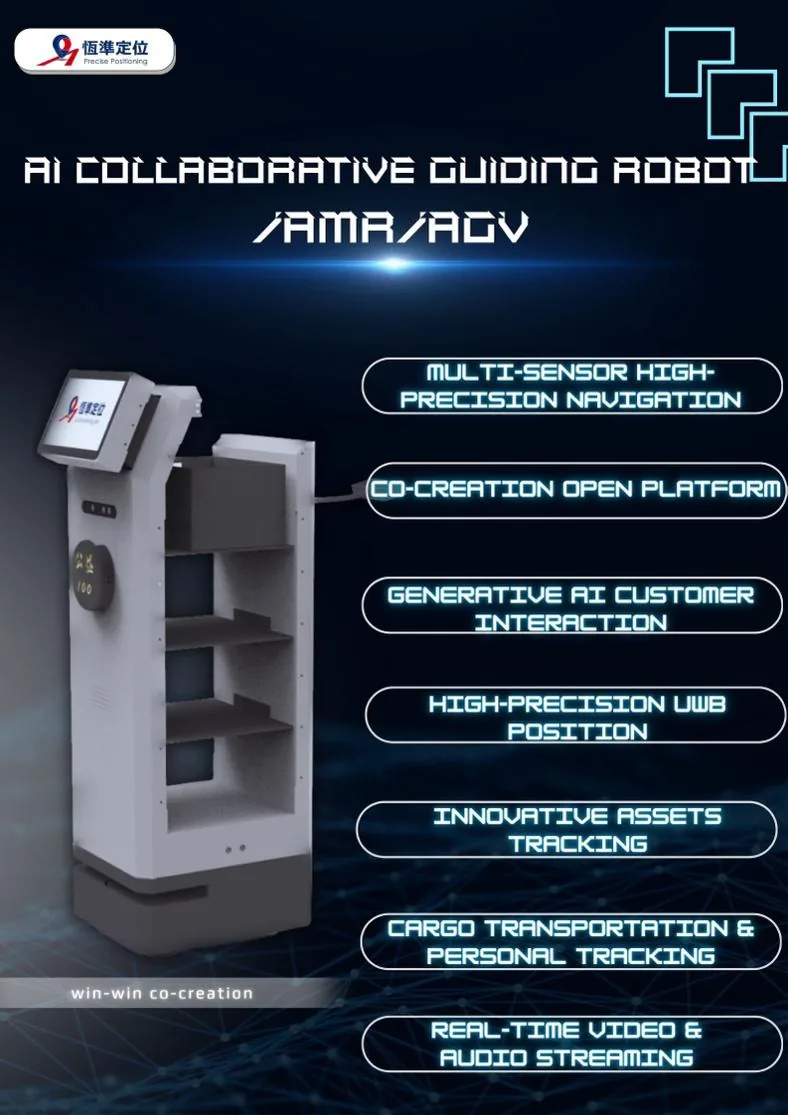
The robot and its capabilities at a glance
High SROI: four sources of value
| Source | Detail |
|---|---|
| Innovative relative positioning | Lidar gives the robot its own position and UWB or an AI camera gives the user’s position relative to it, so the whole site does not have to be instrumented just to obtain location — which brings deployment cost down |
| Location-based generative AI guidance | Generative AI keyed to position, delivering the information that is actually useful at that spot (patent pending) |
| Open co-creation platform with revenue sharing | Straightforward to build on, publish and sell jointly, with revenue shared by agreement |
| Built-in assistance for vulnerable groups | A support handle for those with limited mobility, a storage basket for people with physical disabilities, and generative voice for older adults and students with disabilities |
Where it is used
| Setting | Application |
|---|---|
| Hospitals | Carrying physiological measurement devices and streaming to clinicians remotely; locating and counting mobile equipment |
| Retail | Carrying goods so shoppers’ hands stay free, locating counters, wayfinding and automatic following |
| Schools | Education outreach, an open interface for students and faculty, and a teaching and research platform |
| Stations | Information lookup and directions, easing the load on the service desk |
| Long-term care | Smart patrolling, resident interaction and night-shift support |
Frequently Asked Questions
How is this different from an ordinary service robot?
Why UWB? Are lidar and cameras not enough?
What does the open co-creation platform mean in practice?
Will the generative AI give irrelevant answers?
Where has it been deployed?
Plan an AI-Guided Robot Deployment for Your Site
Contact the P-Square project team to assess how guided robots integrate with indoor positioning.
Professional Consultation