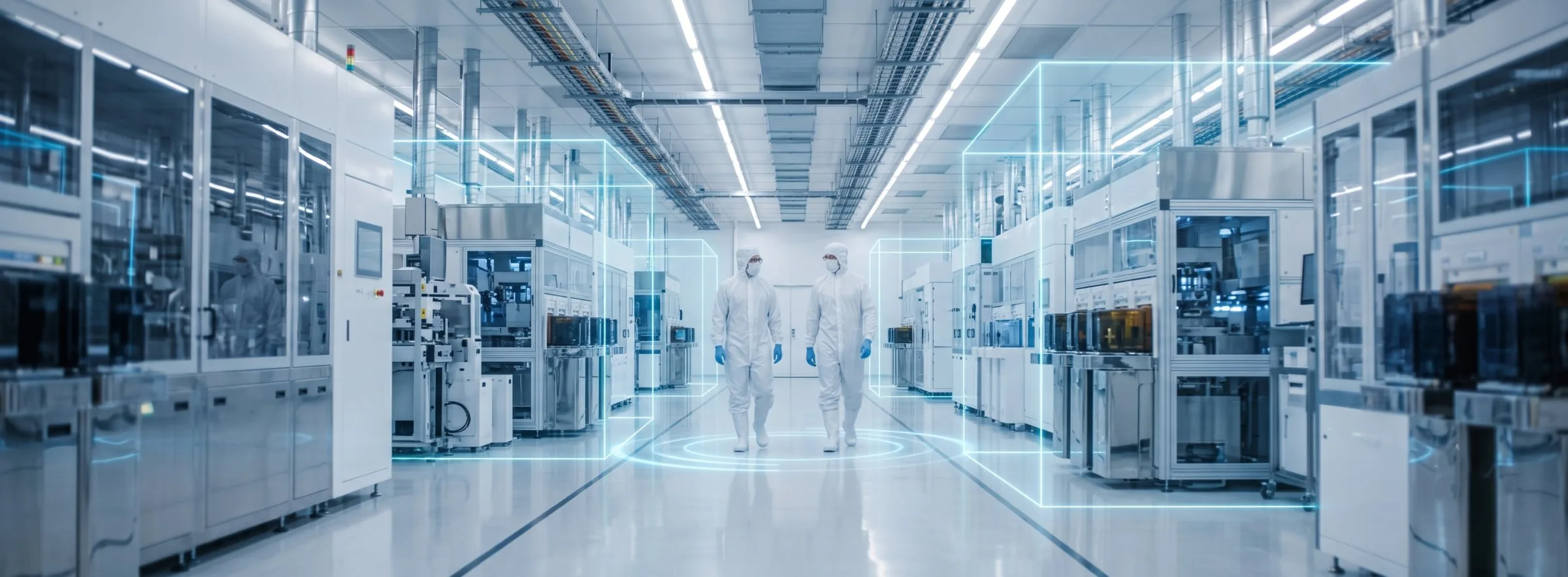
Semiconductor Fab Personnel Safety & Material Tracking System
P-Square delivers an RTLS indoor positioning system for semiconductor wafer fabs, integrating Wi-Fi, BLE and UWB. It addresses cleanroom staff duress, full headcount reconciliation during fire evacuation, lone-worker safety on night shift, and the search time for reticle pods, trolleys and metrology equipment. Measured positioning accuracy outperforms solutions from major international networking vendors, and the system is deployed across multiple fabs of a leading domestic semiconductor manufacturer (Hsinchu and Tainan science parks in Taiwan), supporting zero-incident safety goals and end-to-end process visibility.
Pain Points and Solutions
| Pain Point | Description | Solution |
|---|---|---|
| Personnel safety and duress | Chemicals, specialty gases and lone-worker zones carry high risk; locating a person in an incident is slow. | Staff badge duress button pushes an alert with precise location, integrated with the plant Emergency Response Centre (ERC). |
| Fire drills and evacuation headcount | During a large-site evacuation there is no way to confirm in real time whether every zone has been cleared. | Live display of remaining headcount per zone and the location of anyone who has not reached the assembly point. |
| Night shift and lone working | With minimal staffing at night, a prolonged period of immobility or a fall may go unnoticed. | Automatic alerts on prolonged immobility, protecting lone workers. |
| Search time for high-value materials | Reticle pods, trolleys, fixtures and metrology tools are numerous and move quickly; manual searching wastes production time. | Real-time tracking of multiple material types, heat-map analysis of movement and trajectory replay. |
| Confidentiality and access control | Visitor and contractor movement must be controlled to prevent entry into confidential areas and industrial espionage. | Geofencing with instant alerts on boundary crossing, plus visitor and contractor movement management. |
System Applications

Pressing the staff badge button sends a duress message with precise location, integrable with the plant ERC.

Live personnel positions with automatic alerts on prolonged immobility.

Geofences around hazardous and confidential areas raise instant alerts on crossing.

Movement visibility and access control for visitors and contractors.

Real-time tracking of multiple material types with heat maps and trajectory replay.
Solution Modules
| Positioning Technology | Accuracy | Deployment | Tag / Device | Primary Application |
|---|---|---|---|---|
| Wi-Fi positioning | 3–5 m | Reuses existing plant Wi-Fi APs — no rewiring, excellent cost efficiency | Handheld terminals, Wi-Fi tags | Broad-area personnel positioning, material distribution by zone |
| BLE (low-power tags) | 1–3 m | BLE Locators (one unit drives four read heads, cutting deployment to about a fifth) | Low-power staff badge with duress button, asset tags | Staff duress, asset stocktakes, patrol records |
| BLE Locator + 5G | Room level | Locators combined with the plant private 5G network | BLE tags | Wide-area real-time reporting, integration with facility systems |
| UWB ultra-wideband | 10–30 cm | UWB anchors installed in critical areas | UWB tags | High-precision personnel and equipment tracking, geofencing |
Case Study
Leading Domestic Semiconductor Manufacturer — Cleanroom Staff Duress and Multi-Item Material Tracking
Personnel duress positioning was deployed inside a high-tech fab and integrated with the ERC emergency response system, while precise multi-item material tracking was deployed at another site to improve process visibility and production efficiency. Measured positioning accuracy outperformed solutions from major international networking vendors, and the system is now live across multiple fabs in the Hsinchu and Tainan science parks.
- Substantially faster response to personnel duress events, enabling immediate EHS intervention.
- Significant reduction in time spent searching for materials and trolleys.
- Markedly shorter full headcount reconciliation during fire evacuation.
- Wi-Fi positioning was used for live headcount during fire drills, and the site won first place in the group-wide inter-fab drill assessment.
Highlight — fire-drill headcount: traditional fire drills rely on a manual roll call at the assembly point, which is slow and cannot confirm whether anyone remains inside. With Wi-Fi positioning, the remaining headcount per zone and the location of anyone yet to reach the assembly point are visible throughout the evacuation, dramatically shortening full reconciliation — and the site went on to take first place in the group-wide inter-fab fire-drill assessment. The solution reuses existing plant Wi-Fi APs with no rewiring, making it the lowest-cost route for an operating facility.
Frequently Asked Questions
Semiconductor cleanrooms are full of metal equipment — does that affect accuracy?
Can we reuse the existing Wi-Fi or 5G infrastructure in the plant?
How does the duress function work, and can it integrate with our emergency response system?
How long do personnel tracking tag batteries last?
How does this integrate with MES / ERP?
We keep losing track of materials and struggle to manage people on the floor. Can positioning fix that?
Experienced operators are retiring or leaving and their know-how goes with them. What can positioning and AI do?
Build a Smart Fab with Zero Safety Incidents and Efficient Logistics
Book an online assessment and let the project team plan a positioning solution for your site.
Professional Consultation