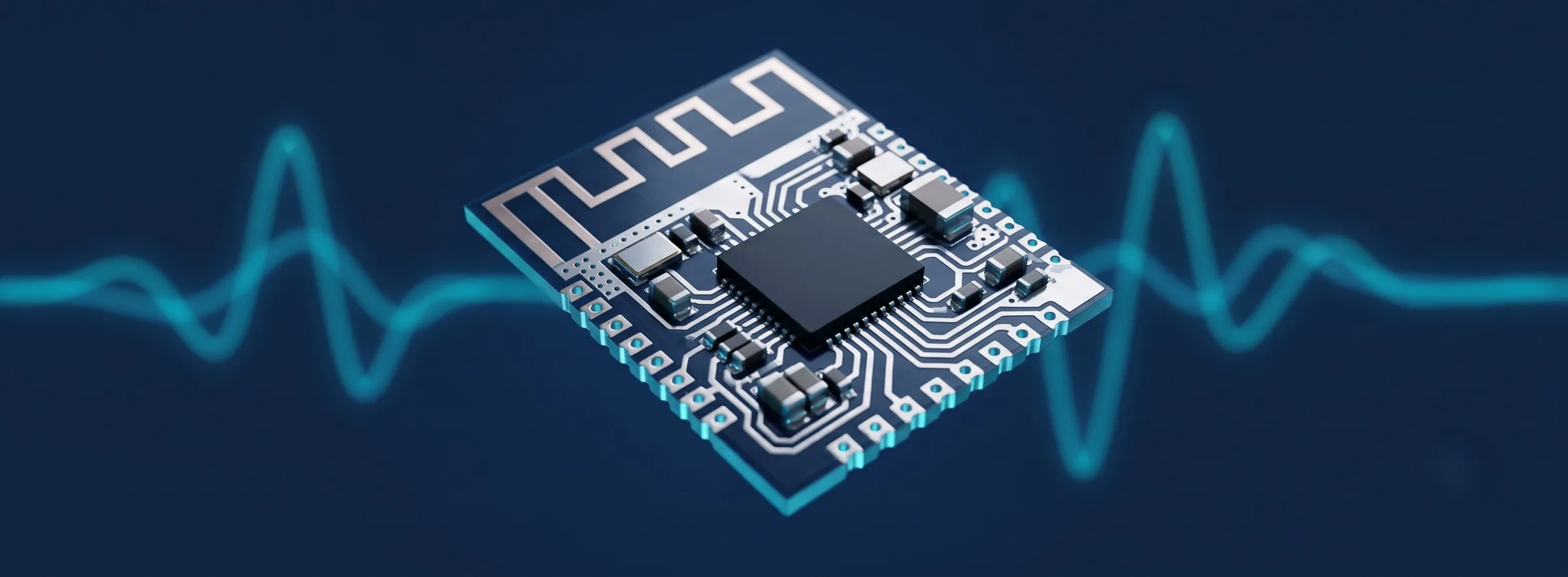
Your silicon measures range. What the customer wants is a position.
Between a ranging value and a stable indoor position sits an entire algorithm layer. P-Square provides a hardware-independent AI positioning algorithm and API that runs on the chip or at the edge, so IC design houses, module makers and IC distributors can turn positioning into a selling point without first building an algorithm team.
2. Industry context: positioning is becoming standard equipment, not an option
[Market signal] The majors have already built positioning into the hardware
Positioning is no longer bolted on afterwards — it is going straight into the silicon and the devices:
- Cisco builds UWB directly into Catalyst series wireless access points.
- HPE Aruba is driving Open Locate, combining Wi-Fi 7 and 802.11az for sub-metre indoor navigation.
- Qualcomm launched Dragonwing IQ10, designed for AMRs and humanoid robots.
- CES 2026 saw Infineon, Nordic and Realtek all demonstrate Bluetooth 6.0 Channel Sounding.
Customer specifications have moved from “supports UWB” to “which room, and to what error”.
[The gap] Ranging is not positioning
What silicon delivers is a raw ranging or signal-strength value. What the customer wants is a stable, trustworthy coordinate. That gap is invisible on the bench and appears the moment you reach a real site:
- NLOS obstruction: bodies, metal machinery and partition walls make the signal detour, so distance is overestimated.
- Multipath: reflections add up, and the same position reads differently from moment to moment.
- Antenna variation: different devices and mounting angles do not read alike.
Closing that gap takes NLOS estimation, a Particle Filter, motion models and pattern matching — a separate discipline.
3. What IC design houses, module makers and distributors run into, and how P-Square answers it
You own the hardware, P-Square provides the algorithm — you do not have to staff an algorithm team before you can ship positioning.
- No algorithm team required: P-Square has worked in real-time location systems (RTLS) for more than 15 years and holds 10 core patents (8 granted, 2 pending). The algorithm and API are ready to integrate, so your engineering stays on your own silicon.
- The site problems are already handled: NLOS estimation combined with a Particle Filter and motion models compensates for multipath and jitter in metal-rich environments; AI Fingerprinting raises room-level accuracy by more than 30% over conventional trilateration.
- Runs on the chip or at the edge: pick the architecture that fits the product and the available compute — on-chip so the module outputs coordinates directly, or at the edge (gateway, industrial PC) to centralise computation and support more tags and sensor fusion.
- Hardware independent, not tied to one vendor: the algorithm supports UWB (ToA / TDOA / PDOA), Bluetooth 4.0 / 5.0 / 6.0 Channel Sounding and Wi-Fi RSSI, with validation platforms already covering Decawave DW1000 and Nordic nRF54L15. When your product line changes vendor or moves up and down the range, the algorithm does not have to be rebuilt.
- IC distributors: a reason to buy the chip, not just a datasheet: distributors sell silicon, but the customer asks whether it will actually locate anything in their building. P-Square’s algorithm and Start Kit drop straight onto the UWB or Bluetooth parts you already carry, so you can put a complete positioning proposal on the table at quotation stage instead of a specification sheet. We back the technical support; the customer relationship stays yours.
- Prove it before you commit: a Start Kit lets you stand the system up in your own environment and measure accuracy and stability before entering product development. Contents and lead time on request — we will suggest a combination that matches what you need to prove.
4. A flexible partnership model
| Item | Owner | Detail |
|---|---|---|
| Silicon / module hardware | Your company | Design, production, channel and brand — the hardware and the customer relationship stay yours. |
| Positioning algorithm and API | P-Square | Ranging and signal processing, NLOS estimation, pattern matching, coordinate output and integration documentation. |
| Evaluation and rollout support | Both | Start Kit trials, accuracy validation, anchor density guidance and on-site tuning. |
| Market development | Both | Selling together and joining customer projects together. |
| Government innovation grants | Both | Applying jointly for innovation and industrial-upgrade grants (Ministry of Economic Affairs, National Science and Technology Council and similar programmes): P-Square supplies the positioning algorithm and the technical content, you supply the silicon, the modules and the field validation, which lowers the up-front risk on both sides. |
A partnership only lasts if all three sides win — the partner (product differentiation), the customer (a high value-for-money solution) and P-Square (co-creating with partners and customers).
5. Frequently asked questions
Our silicon is from Decawave, Nordic or another vendor. Does that work?
Where does the algorithm actually run?
What is the Start Kit, and how long does an evaluation take?
Is this a purchase of modules from P-Square?
Or email service@p2-positioning.com · Tel +886-3-666-9151