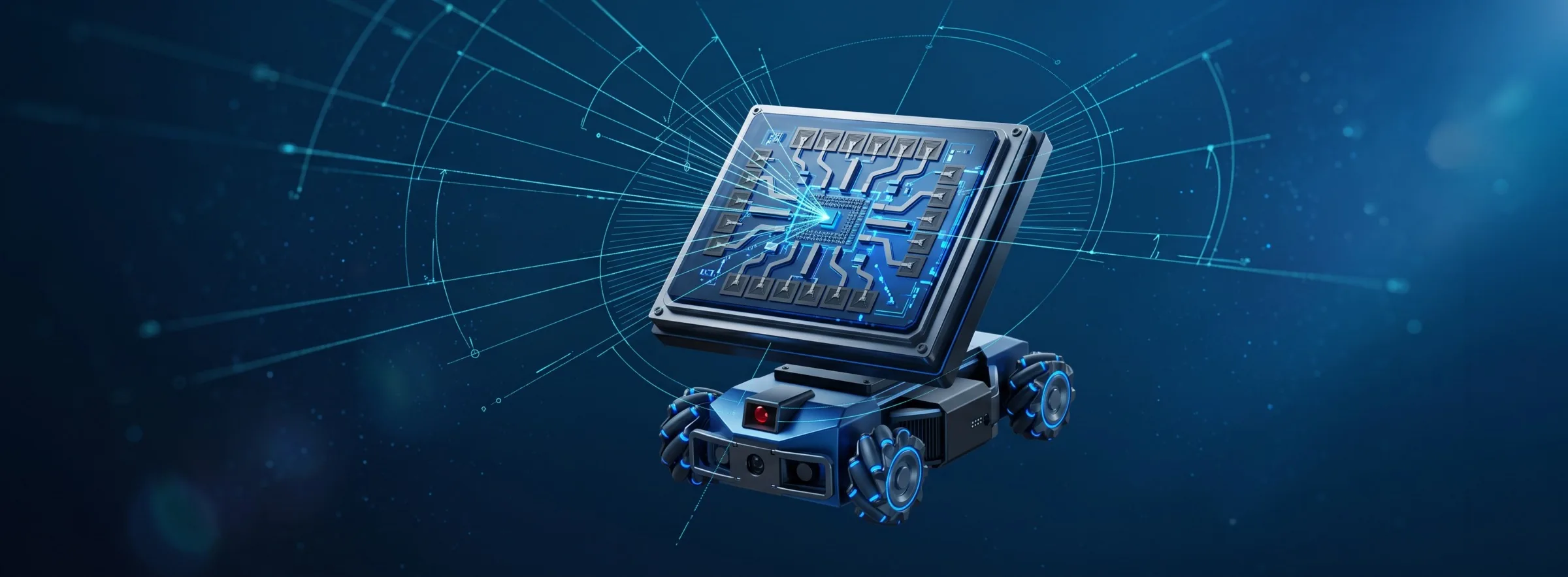
Let Your AGV / AMR Know Where People and Assets Are, Even Through a Wall — AGV / AMR Vendors Welcome
An AGV's LiDAR SLAM answers where it is, but not whether anyone is nearby. P-Square seeks AGV / AMR vehicle manufacturers, controller makers and module vendors to co-create vehicle-mounted relative positioning — put the UWB anchor on the vehicle so it measures the bearing and distance of nearby people directly.
2. Industry Focus: Mixed-Traffic Safety Is Rewriting AGV Specifications
The more automated the site, the heavier the mixed-traffic safety burden
AGV and AMR density keeps rising, but most factories and warehouses are not fully unmanned — workers, forklifts and AGVs sharing an aisle is the norm. Corners, gaps between racking and junctions concentrate collision risk, while occupational safety management increasingly demands traceable event records. Safety capability is moving from a bonus feature to a mandatory line in the specification.
Three things buyers care about
- Reacting early: not stopping on contact, but slowing before entering the blind spot.
- Telling people from objects: a pallet can be passed closely, a person cannot — but LiDAR sees only contours.
- Reconstructing afterwards: whether the relative positions and trajectories of people and vehicles can be recovered after an incident.
The gap: SLAM answers where I am, not where the people are
LiDAR SLAM localises the vehicle by matching environmental contours, and does so well. But it has two structural limits: it cannot identify moving objects — it does not know whether a contour is a person or a pallet — and it is bound by line of sight, so corners and areas behind racking are invisible. For safety applications, what a vehicle actually needs is not its absolute coordinate but the bearing and distance to the nearest person.
How UWB relative positioning covers it
- No line of sight required: radio signals pass through racking and partitions, so blind spots are still measurable.
- Identity is inherently unique: a tagged worker has an unambiguous ID, with no image re-identification needed.
- Works while moving: the anchor is on the vehicle, continuously measuring range and bearing to surrounding tags as it travels.
3. Development Pain Points for AGV Vendors, and What P-Square Offers
AGV and AMR vendors are strong in navigation, control and mechanics; personnel positioning belongs to a different technical domain — which is where P-Square fits.
What P-Square provides:
- Vehicle-mounted relative positioning: put the anchor on the vehicle: Conventional RTLS mounts anchors on walls and tags on people, which requires site-wide deployment to be useful. P-Square adds another option: mount a UWB PDOA multi-antenna anchor on the AGV or AMR and resolve the range and bearing of surrounding tags directly from array-antenna phase difference. It keeps working while the vehicle moves, and the site needs no large-scale deployment.
- Complementary to existing sensors, not a replacement: LiDAR SLAM and encoders localise the vehicle; RGBD imaging compensates for LiDAR's limited field of view and assists obstacle avoidance; UWB relative positioning identifies the bearing and distance of people precisely. All three complement each other, so your existing obstacle avoidance design is retained and simply gains an earlier reaction layer for people.
- Multi-vendor fleet management and deadlock resolution: The P-Square fleet management system supports AGVs and AMRs from different manufacturers, tracking actual position and task status across the fleet and arbitrating right of way at junctions and narrow segments to resolve fleet deadlock.
- A complete back end and standard integration: Restricted zones, historical records, heat maps, trajectory replay and dwell-time analysis are all ready-made. Web API and iframe integration connect to existing MES, WMS or dispatch systems, and traffic and zone control alerts can be delivered as events for the dispatch system to slow or stop a vehicle.
4. Flexible Partnership Models: Co-Creating a Win-Win
Different integration depths depending on your product stage:
| Partnership model | Who it suits | What it involves |
|---|---|---|
| Vehicle-mounted module add-on | Existing AGV / AMR vehicle manufacturers | An add-on vehicle-mounted UWB module gives current models personnel relative positioning without redesigning the vehicle or controller. |
| Controller onboard integration | New-generation model developers / controller vendors | Integrate the positioning module and algorithm into the controller at the design stage for a differentiated model combining navigation and human awareness. |
| Fleet management software joint selling | System integrators and factory automation providers | Ship the P-Square fleet management system alongside your existing AGVs, supporting multi-vendor fleets to form a complete intralogistics solution quickly. |
| Joint government project applications | Listed and pre-IPO companies, automation majors, system integrators | Apply jointly for government smart manufacturing, occupational safety and smart-facility grants, reducing R&D risk. |
5. Frequently Asked Questions
Our AGVs already have LiDAR SLAM and obstacle avoidance — why add UWB?
Must every worker wear a tag? What about people without one?
Does the site need anchors deployed?
Can you support our customers' existing AGVs from different manufacturers?
Is this a module purchase relationship?
Or email service@p2-positioning.com · Tel +886-3-666-9151